

The book of masks, p.1
The Book of Masks, page 1
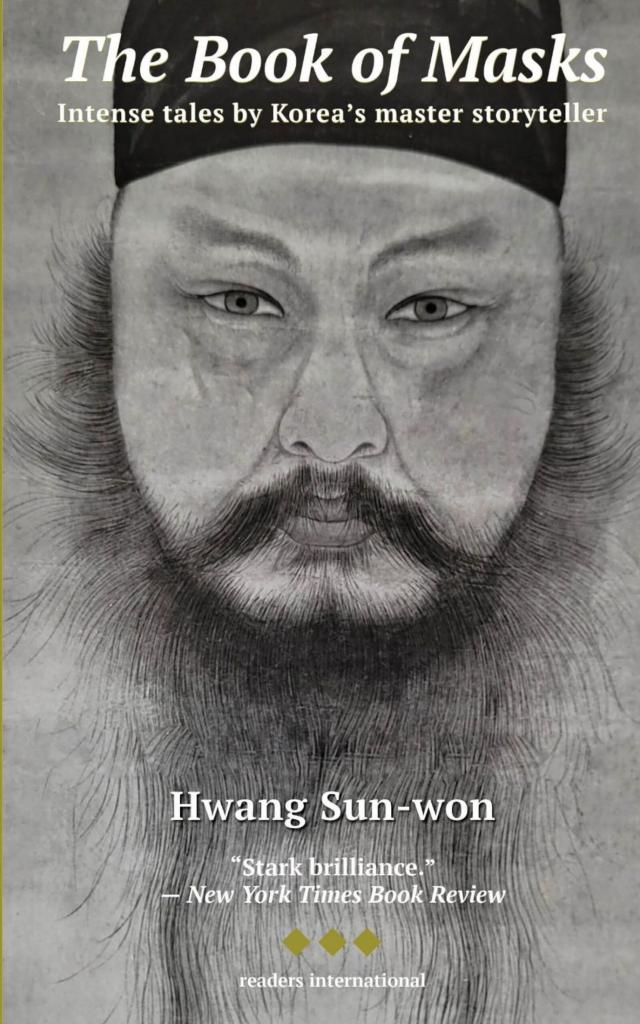


The Book of Masks
Hwang Sun-won
Edited with an Introduction by Martin Holman
Readers International
Korean originals © Hwang Sun-won 1976, 1980, from 2000 © estate of the author
Published in English by Readers International Inc., and Readers International, London. Editorial inquiries to London office at 8 Strathray Gardens, London NW3 4NY England. US/Canadian inquiries to North American Book Service Department, P.O. Box 909, Columbia LA 71418-0909 USA.
English translation copyright © Readers International Inc. 1989, 2022 All rights reserved
Introduction copyright © Martin Holman 1989
A Numerical Enigma, For Dear Life and The Night He Came Late reprinted with kind permission of the translators. The Weighted Tumbler reprinted with kind permission of Korea Journal. Readers International also acknowledges with thanks the cooperation of the Google Book Project in the production of this digital edition.
Cover art: unusual Self Portrait by classical Korean artist Yun Du-so (1668-1715), in the collection of Mr Yun Young-son, used courtesy of The National Museum of Korea. Digital cover design by BNGO Books.
Library of Congress Catalog Card Number: 88-63251. The British Library also holds a catalog record for this title.
ISBN 9780930523589
EBOOK ISBN 9781887378390
Acclaim for The Book of Masks
“These stories transcend one culture, focusing as they do on moments of empathy in which bruised souls find solace in fleeting intimacy…. In the terseness of his cadences and the concentrated simplicity of his language, Mr Hwang’s stories have the fullness and tension of lyric poetry.”
NEW YORK TIMES BOOK REVIEW
“An extraordinary collection…filled with surprises, with turns and depths of plot and characterization that remind one of just how much room for imagination there can be in a few pages. Although the stories are full of Korea, they are not at all ‘Korean’ in any whimsical, tourist sense. Recommended.”
CHOICE
“Small but pivotal moments that are always evocative, although sometimes enigmatic…Stories that work by indirection and suggestion, delicate and metaphorical.”
KIRKUS
“Hwang Sun-won…is a literary giant of a Korean generation that came into contact with the early tide of Western influence in the 1930s…. An extremely varied and versatile writer who began as a poet, made his reputation with lyrical stories of village life and went on to address the harsh realities of war and urban deprivation…. He shows a preference for considering the poorest and most disadvantaged, and often forces our sympathies in unexpected places. Always compulsively readable.”
THIRD WORLD QUARTERLY
“In this memorable collection, South Korean virtuoso Hwang proposes that the divisions we perceive – enemy/ally, growth/decline, North/South – are purely deceptive, artificial…Martin Holman’s introduction underscores the poignancy of Hwang’s vision of the unity of existence by sketching the tumultuous political history of 20th-century Korea.”
PUBLISHERS’ WEEKLY
“Wonderfully crafted vignettes of contemporary lives.”
FAR EASTERN ECONOMIC REVIEW
“One of the most remarkable features of The Book of Masks is Hwang’s sensitivity to the ways in which his people are limited in their choices and are often victims of a world created by others…. It is a credit to the universality of Hwang’s vision that his books need not be placed on a shelf next to the rest of the ‘books on Korea’, but can find a place among the best of the storytellers.”
PACIFIC AFFAIRS
Contents
Acclaim for The Book of Masks
Introduction by Martin Holman
Masks
Conversation in June about Mothers
A Numerical Enigma
Winter Forsythias
Folding the Umbrella
For Dear Life
Blood
The Night He Came Late
In a Small Island Village
Shadows of a Sound
The Weighted Tumbler
Nature
The Curtain Fell, but Then...
Places of Death
A Tree, a Rock, and ...
About the Author
About the Translators
About Readers International
Introduction by Martin Holman
HWANG SUN-WON began his literary career 58 years ago with the publication of his first poem when he was 16. In the years since, he has distinguished himself as a poet, a novelist, and a writer of short stories in his native Korea, where his name is a household word. He has written over 100 short stories, which appeared in eight collections published from the nineteen thirties to the mid-seventies. He produced two volumes of poetry early in his career, and also has authored seven novels, including his Trees on a Cliff (translated into English by Chang Wang-rok) and The Moving Castle (translated into English by Bruce and Ju-chan Fulton), both of which won major literary awards in Korea. Today, at the age of 74, Hwang still writes and teaches creative writing.
When Hwang was born in 1915 in what is now North Korea, his nation had already been under Japanese rule for five years. In the late nineteenth century, as the five-hundred-year-old Yi Dynasty of Korea began to feel the pressure of encroachment by Western forces, Japan positioned itself to annex Korea in a move to procure colonies after the fashion of Western powers. By 1910 the Japanese had acquired enough influence in Korea to take over the country, thus beginning 35 years of colonial occupation.
Under colonial rule, Korean children were educated in Japanese schools, part of an effort to “assimilate” Korea into the expanding Japanese empire. Attempts to turn Koreans into Japanese took many forms; at various times such “subversives” as the compilers of a Korean language dictionary, those who opposed Japanese rule, and many others were subjected to imprisonment and torture for what was viewed as Korean nationalistic activities. At one point Koreans were even required to give up their Korean names and adopt Japanese ones. Hwang was educated and did his early writing under these adverse conditions. For his higher education he went to Japan, graduating with a degree in English Literature from Waseda University in Tokyo in 1939.
In Japan, Hwang was exposed to the very active literary world of Tokyo in the 1930s when such young, prominent Japanese writers as Kawabata Yasunari and Tanizaki Jun’ichiro were active. Hwang’s experience in Japan gave him an opportunity to sharpen his vision and view his own culture from afar. But when he returned to Korea after the completion of his degree, he found Japanese control growing tighter. Eventually Hwang went into hiding to avoid conscription by the occupation authorities. In 1942, the Japanese outlawed all publication in the Korean language as their Pacific war efforts expanded. During the subsequent years before the liberation of Korea with the Japanese surrender in 1945, Hwang and other Korean authors continued to write secretly with the uncertain hope that their works would one day see the light of day.
Before the liberation, resistance movements, both nationalist and Marxist, had already developed among the Koreans. The 38th parallel was originally chosen merely as a boundary to facilitate division of the responsibilities of the United States and the Soviet Union in accepting the surrender of Japanese troops on the peninsula; however, the line soon hardened into an ideological boundary. Hwang’s home had been in the North where he had hoped to remain, but the tyranny and terror of the communists prompted him to flee to the South with his family in 1946.
When the Korean War broke out in 1950, many Koreans fled before the advancing communist army which soon occupied the entire peninsula except for an area around the southern port city of Pusan. Hwang and his family spent much of the war as refugees here while the war front swept back up and down the peninsula, ravaging a nation that had already been plundered by thirty-five years of foreign occupation. South Korea was assisted by United Nations forces, while the North was eventually joined by the Chinese army. By the time an uneasy peace settled over the land in 1953, hundreds of thousands of Koreans on both sides had lost their lives, farms and industries had been destroyed, and the 38th parallel still divided the Korean people. The war and partitioning of Korea separated hundreds of thousands of families, many of whom are only now being reunited from their scattered locations within South Korea, not to mention those whose relatives live in the North beyond the demilitarized zone, who hold little hope of being reunited.
Recovery from the Korean War -- political, economic, spiritual, and emotional -- has been a painful process. The first government of South Korea instituted after the liberation war was racked by corruption and was toppled in part by the success of the April 19 student revolution of 1960, which crystallized public sentiment against the regime of President Syngman Rhee. The democracy that followed Rhee was short-lived; General Park Chung-hee took power in a military coup that lasted until his assassination in 1979. This period saw rapid industrial growth, but inequalities. of wealth left many Koreans out of the nation’s economic advancement.
In 1988, Korea became the focus of world attention when Seoul hosted the Olympics, as well as many other international events, including the International P.E.N. Congress. Most Koreans are justifiably proud of the progress they have made as a nation; and, while there appears to be guarded but growing optimism, grave problems still trouble the Korean people: reunification is still a major preoccupation, however unlikely the prospects appear; labor unrest and government responses to it threaten the stability of the industries that have spawned the so-called economic miracle of this “little tiger” nation; the desire for expanded personal freedom often seems to run counter to the demands of national security.
Hwang has lived in or around Seoul, the center of modern Korean culture, since the end of the Korean War. In his life, which spans the great portion of modern Korean history, he has witnessed the myriad political, social, and economic changes that have come over his country, but his literature can be said to reflect those changes only in an oblique fashion. Hwang’s literature does not so much depict his society as it does the individuals’ reactions -- often very personal ones -- to it. Hwang has never made his own politics a matter of literary record nor has he ever affiliated himself with any of the many literary movements that aroused the passion and claimed the devotion of some Korean writers in this century. Such writers as Yi Kwang-su, who wrote what is considered Korea’s first modern novel, Heartlessness, regarded literature as a tool to educate and enlighten the people in a modernizing society, and for some time in the 1920s a debate raged between Yi and Kim Tong-in, whose hedonistic lifestyle and insistence on art for art’s sake were in direct opposition to Yi’s views. Proletarian writers also appeared, but they fared poorly under Japanese oppression, as did any writers who dared to criticize the colonial regime. And since the liberation of 1945, most literary movements of the West have found voices in Korea as well. In recent years, Hwang’s literature has come to be regarded as unresponsive to the needs of a rapidly developing society by some who follow younger, so-called socially committed writers. But Hwang’s literature does not evade the problems of society; it recognizes and explores the constants in man’s reaction to society, and those constants involve the universal workings of the soul.
Through almost six decades of writing, something central to Hwang’s work has remained unchanged: his devotion to his art coupled with a devotion to his subject, human life. Prof. Suh Ji-moon of Korea University in Seoul, some of whose translations appear in this book, has described Hwang’s literary demeanor as being a product of his “aestheticism and ascetism.” She describes his aestheticism as “a rigorous search for exactly the right form to convey his meaning and a disciplined quest for the image that encapsulates a whole personality, emotional complex, or historical heritage. Thus it is inseparable from his asceticism.” Hwang has not ignored his time in his literature, although there was often little other choice during the Japanese occupation, a time when the literature of Korea makes conspicuously little mention of the Japanese, and opposition appears only in veiled references. His characters do confront the political and social problems of their age; the wounded young man in “For Dear Life” has participated in the April 19 student revolution that brought the downfall of the Rhee government, and the schizophrenic narrator of “A Numerical Enigma” also takes up his role in the movement. But Hwang has chosen to deal with those characters in a manner that transcends time as well as place. Their reactions to their world are personal, not public, and they lead toward universal themes that are immediately comprehensible across time and from East to West.
Hwang’s literature takes up questions that touch all people everywhere: among others, human loneliness and the passage of time, the loss of innocence, and the uneasy distance between men and women. While these inherent problems of existence have led some writers to despair, there is a strong moral underpinning to Hwang’s work that suggests hope, resolution, and meaning. Hwang often portrays characters who are lonely and isolated, but ultimately he shifts his focus on their lives from the bleak emptiness they often experience to the exquisite nature of their moments of juncture. In his 1958 story “Ringwanderung” (the title, a German word, refers to the tendency of a hiker without any kind of guide to veer consistently in a circle unaware of his deviation), Hwang compares the lonely wandering of humans through life to
travel along the remote reaches of a lonely circle. But the desolation is not his emphasis.
Surely the two of us had been wandering unknowingly in circles. When wandering in a circle, some people go left while others go right…. But in Ringwanderung, the most important thing -- more than anything else
-- is the moment when the two circles meet.
Hwang’s focus is the point of juncture, of communication.
Often this intersection involves reaching across the years to ignite a spark of contact that gives significance to his characters’ lives and rescues them from dark loneliness. In “Old Man Hwang”, a story written in 1942 and loosely based on Hwang’s own grandfather, a self-reliant widower farmer tries to shun festivities that have been prepared for his own sixtieth birthday celebration. When an itinerant musician appears at his gate hoping to be hired to entertain, the farmer recognizes him as a boyhood friend, long forgotten, and they share wine and memories, away from the noisy gaiety of his neighbors who are celebrating without him. They sit in the shadows in a room together and return to their youth, sharing wine in a communion with their past.
The narrator of “Shadows of a Sound,” in the present volume, makes a connection with his past, though this must come from beyond death. Perplexed by his inability to grasp something of substance from what he sees now as a grown man on his return to his childhood hometown, the man is touched from the past and transformed in a peculiar, private way by a long forgotten boyhood friend who is now dead.
The loss of innocence figures as a concern in a number of Hwang’s stories. In “Blood,” in this collection, a father discovers the mercantile blood-thirstiness his six-year-old son has learned, even as the father finds himself victimized by others. Hwang’s best-known story in Korea, “The Cloudburst” (“The Shower” in some translations), written in 1952, which depicts a young country boy and a girl recently moved from the city, is widely regarded as a portrait of puppy love, the pure relationship of children. However, disturbing, ominous images surround the two: the clear, gentle stream they had crossed on the way out on a walk through the countryside grows turbid and raging on their return after a sudden shower forced them to seek shelter in a field.
The city girl in “The Cloudburst” is also an example of the powerful women, often worldy-wise, who appear in a number of Hwang’s stories. “The Night He Came Late,” “Conversation in June About Mothers,” and “The Curtain Fell, but Then...” all demonstrate a mystical feminine power that begins with the preeminence of the image of mother, an image that colors or twists all subsequent male-female relations.
The stories in The Book of Masks are all drawn from Hwang’s last collection of short stories, which was published in 1976 under the title T’al (Masks). The stories, written between 1965 and 1975, take up themes familiar to readers of his earlier work and show the insight and incisiveness of the masterful hand of mature experience.
Hwang’s choice of “Masks” as the title story for his last collection is significant. Masks appear in most cultures of the world and serve a variety of purposes. The mask may be used to conceal or to change identities. It may be considered a work of art in itself, or perform a dramatic role on stage. Perhaps the most common function of the mask lies in religious ritual where, rather than concealment, its purpose is revelation.
Masks are seldom intended to be realistic portraits, except for the death masks of Europe that were meant to reproduce accurately the features of the deceased; most masks are stylized conceptions of their models. The mask presents the distillation, the essence of the subject, often supernatural. The power of the mask lies in its ability to link two worlds: the sacred and the profane, the young and the old, the living and the dead. The maker of masks is revered in many cultures for his ability to give physical form to the essence of the subject, a capacity that suggests he is in contact with the supernatural.
As a maker of “masks,” Hwang strives to draw together the local and the universal. His stories are firmly rooted in the soil of his native Korea, but they are immediately comprehensible and moving for readers far removed from the source. Although his settings and situations are peculiar to this nation in this northeast corner of Asia, his concerns are the concerns of all humanity.






