Manhunt, p.1
Manhunt, page 1


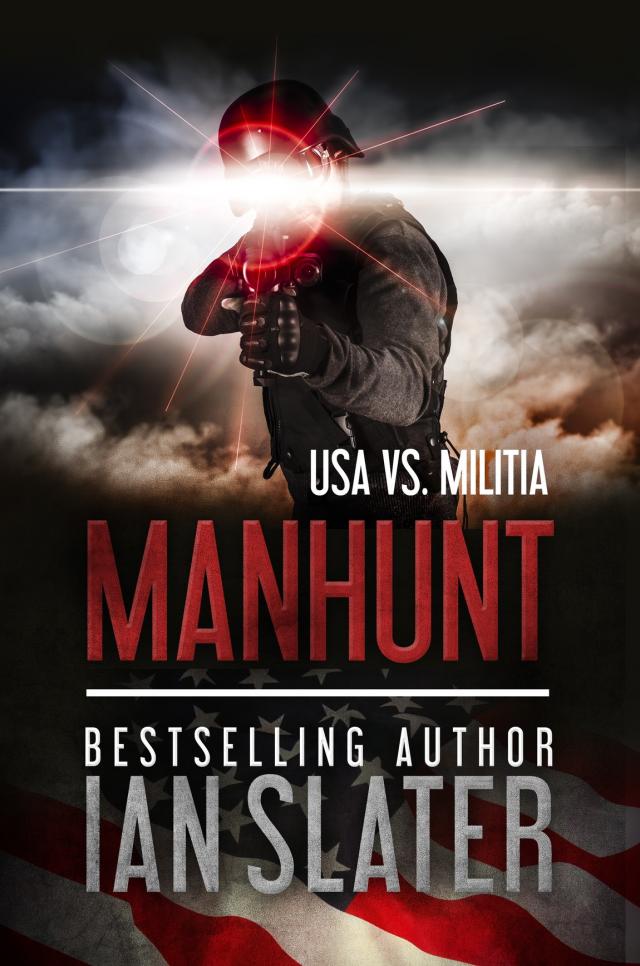
Manhunt
USA vs. Militia
Ian Slater
Copyright
Diversion Books
A Division of Diversion Publishing Corp.
443 Park Avenue South, Suite 1004
New York, NY 10016
www.DiversionBooks.com
Copyright © 1999 by Bunyip Enterprises, Inc.
All rights reserved, including the right to reproduce this book or portions thereof in any form whatsoever.
For more information, email info@diversionbooks.com.
First Diversion Books edition November 2013
ISBN: 978-1-62681-182-9
Also by Ian Slater
Firespill
Sea Gold
Forbidden Zone
Battle Front: USA vs. Militia
For Marian, Serena, and Blair
I am indebted to my wife, Marian, whose patience, typing, and editorial skills continue to give me invaluable support in my work
Prologue
WASHINGTON, July 1—Federal authorities today arrested twelve people it said were members of an Arizona paramilitary group … The authorities said that those arrested called themselves the Viper Militia and trained in the desert with explosives for what one member said was an “upcoming war” with the federal government.
—The New York Times
Chapter One
Phoenix
The panicky call came into Holy Rosary during rush hour, shortly after five. The shaky voice informed the hospital’s emergency room that there’d been another clash between federal authorities and Arizona’s Scorpion Militia north of the city. Ambulances were already en route to Holy Rosary, where casualties from earlier confrontations between federal troops and the USMC—United States Militia Corps—were now receiving medical treatment under a twenty-four-hour police guard. On Interstate 10 some cars managed to pull over to the shoulder; others, unable to change lanes, simply stopped where they were as the five wailing ambulances, preceded by two motorcycle policemen, wove their way through heavy traffic.
At the hospital, reflections of the flashing lights of the police outriders and ambulances danced madly in the emergency ward’s sliding glass doors. The staff had been alerted and was waiting, ready to perform triage the moment the stretchers were wheeled in. The first ambulance’s doors opened, the two motorcycle policemen waving onlookers aside as a stretcher bearing a man with bloodied, matted hair sticking to his forehead and breathing laboriously through an oxygen mask was quickly wheeled in.
With this first arrival, a warm push of air invaded the antiseptic smell of the emergency room. A security guard watched as the man was wheeled inside. “It’s okay!” one of the motorcycle cops told him, booting his kickstand down. The guard nodded self-importantly, eyeing the interested onlookers outside, determined not to let any unauthorized personnel through the doors, especially the press. Since the federal-militia flare-up in Washington State, some of the wounded militia leaders, like Colonel Vance and Captain Lucky McBride, had been moved here to Phoenix, to stand trial by juries who weren’t from the Northwest. But nosy tabloid and even mainstream press types would occasionally try to sneak in to interview anyone, including the police guards posted outside the rooms of Vance and McBride.
A trim intern in her mid-twenties, her emerald-green eyes conveying a no-nonsense air, immediately took over as the resident was called to the phone. As the two ambulance attendants wheeled the patient in, the young intern indicated the nearest bay to a nurse. The intern, whose name tag identified her as Dr. D. Teer, moved inside with the patient and the two ambulance men, the nurse entering last and drawing the yellow modesty curtains. Dr. Teer felt the man’s pulse as the two ambulance men undid the stretcher’s restraining straps, reaching under the patient’s blanket and withdrawing two nine-millimeter Sig/Sauer machine pistols and pushing the two women up against the wall.
Dr. Teer’s pager started beeping.
“Turn that off,” the taller of the two ambulance imposters ordered quietly.
The third man, the “patient,” sat up, holding a .44 Magnum.
“Listen carefully,” the ambulance man continued, “You’re to tell whoever’s in charge on floors two and four that you’re being held hostage by the militia, that they’re to go get Colonel Vance and Captain McBride and bring them down here—now! Any screwing around and you get it right between the eyes. You understand?”
Dr. Teer nodded and Nurse Beverly Malkin tried to speak but couldn’t, the gun of the smaller, stockier man against her jugular.
“Then do it,” said the tall one, a lean man in his late twenties. “And punch the right fucking numbers. No 911.”
The doctor lifted the phone from its wall bracket and pushed the five digits of Holy Rosary’s internal emergency number. “It’s Dr. Teer here,” she said. “Nurse Malkin and I are being held hostage. Bring Colonel Vance and Captain McBride down to Emergency now.” There was a pause, then, “Don’t argue with me. I said now. And alert security that they’re to stand aside. I repeat, we are being held hostage. Bring them down now.”
“Good girl, Dana,” the tall man said. “Now I want you to order whatever you and Beverly here need to take care of Colonel Vance and Captain McBride. We’re going on a little trip.”
The “patient,” a short, red-haired man still sitting on the gurney, retrieved a walkie-talkie from under the blanket. He winked at Teer. “How you doin’?”
She ignored him and told the tall one, “Colonel Vance and Captain McBride are too wounded to be moved.”
“Don’t con me,” he replied. “They’re over the worst. We know when they can be moved. All you have to do is call up the dispensary and get the stuff you need. Don’t forget anything. And keep your voice down.”
She called the pharmacy. The line was busy. She was still in shock. How did he know her first name was Dana? It could only mean that these men had planned it carefully, even knowing who would be on shift. She now recognized Michael Hearn’s face from TV’s America’s Most Wanted. He was one of the militiamen who’d escaped from federal custody at Camp Fairchild up in Washington State. She’d never seen a harder face. She called the pharmacy again and told them what she wanted. Replacing the phone in its cradle, she said, “You know you won’t get away with it.”
“You may be right,” Hearn replied, surprisingly calm. “But we’re gonna give it the ol’ American try. And if we go down, honey, you and Florence Nightingale here—”
The curtain moved. The smaller militiaman glimpsed a face through the slit, whirled about, and fired at the same time as the security guard. The dark-haired militiaman was dead before he hit the floor, and the security guard was writhing and screaming in a pool of blood.
The “patient” held the .44 Magnum on the two women as Hearn yelled into the walkie-talkie, “Foxtrot go!”
Dana Teer and Beverly Malkin, the nurse’s face drained of color, stood frozen in front of the phony patient. He jammed the Magnum’s huge barrel into Dr. Teer’s back, the air thick with the odor of blood from the security guard and the dead militiaman.
Seconds later Teer and Malkin heard a soft rush of feet as the Vibram-soled boots of twenty militia assault troops in full desert camouflage uniforms poured in from the other four ambulances. There was a cry for them to stop, a thud, and the crack of broken bone on the hard, polished floor. Half the militiamen stormed the stairwell then, several steps at a time. They were heading for the second floor and McBride. The other ten men commandeered the elevator for the fourth floor, where Colonel Vance could be found.
Chapter Two
General Douglas Freeman was astonished. With over thirty years in the military—from ’Nam, the Gulf, to Bosnia and beyond, and then called out of retirement by the White House because of the increasing militia threat—he had assumed he’d seen it all. Known as George C. Scott among his Special Operations forces because of his striking physical resemblance to the movie actor who’d played the role of legendary General George Patton, Freeman was now learning something more. Here, in California’s Mojave Desert, his steel-blue eyes had witnessed something that not even his fecund imagination had thought possible.
“Most amazing damn thing I’ve ever seen,” he told Colonel Norton, his second in command.
“Ditto for me,” Norton replied, both men’s faces, despite their sunglasses, creased by the hard glare of the Mojave’s sun-bleached sky.
“American know-how,” Freeman said. “By God, Norton, you can’t beat it.”
At times the general’s chauvinism, like that of George Patton, could be embarrassing, especially during joint exercises with allies. But at this moment on the hard-baked earth of the artillery range, Norton too took pride in his country’s technological genius—its love affair with gadgets, with the machine, with everything from electric toothbrushes to the Mars lander.
“This shell,” Freeman told Norton, indicating the nearby pile of neatly stacked 155mm artillery rounds, “with its ability to carry either cargo or a high explosive warhead, will revolutionize warfare.” He was talking about the revolutionary Savage system, named after Master Sergeant Ernie Savage. Packed with munitions instead of high explosive, Savage rounds could deliver two hundred 5.56mm M-16 rounds for every combat soldier in a six-hundred-man battalion in less than thirteen minutes. The payload of each 155mm shell, the liaison artillery officer explained to Freeman, drifted earthward via a drogue chute deployed by a smal l explosive charge in the nose of the shell. The main chute deployed a short time later, the shell maintaining its flight path until falling to earth about a half mile beyond the first-aid target or the combat area target.
“At present,” the liaison artillery officer added, “we’re working on a high-capacity projectile that will have a longer range and will house antitank rocket launchers and grenades—both hand and rifle grenades.”
“How about more medical supplies?” Freeman asked.
Another artillery officer came up and tapped Norton on the shoulder. “Phone, sir.”
As Norton excused himself, Freeman, staring grimly into the desert, said to the liaison officer, “I was thinking of our Rangers in Somalia. In ’ninety-three. Fighting one of the battles in that godforsaken capital—Mogadishu. Our medics had exhausted all their intravenous supplies. Some of ’em were crying as they carried out triage—forced to decide who needed what the most. Had to rip IV drips out of some boys to put in others.” The general was shaking his head. “For the American army to run out of supplies like that, goddamn—”
“Sir,” the liaison officer hurried to assure him, “with Savage, we can supply frontline medics with all kinds of stuff—not just blood and plasma. We can shoot in everything from Band-Aids to bone saws, electric monitors, urgently needed drugs, IV drips. More hypodermics, morphine, surgical instruments—you name it.”
“Good,” Freeman said. “You know, eighty percent of all deaths caused by battle wounds occur in the first hour.” It was more a statement than a question.
“Yes, sir.”
“Well, Captain, let’s hope we don’t have to use it.”
“Amen to that, General.”
Norton returned to inform Freeman that the news media was reporting a militia attack of some kind in Arizona.
Chapter Three
The first of the ten militiamen to reach the second floor of Holy Rosary jerked back the hydraulically hinged door, the nine men behind him streaming into the highly polished corridor. A nurse’s aide in a crisp blue uniform saw them, dropped a tray of juice containers, and ran back into the nurse’s station. The cop sitting on a chair outside Room 201 saw her flee and looked down to the other end of the corridor. There, he glimpsed the banana-shaped mag of a Kalashnikov, and jumped to his feet, drawing his weapon. He was flung back, dead, before his .38 cleared the holster, the forward militiaman’s AK-47 burst punching the policeman up against the wall, where he slid down, his blood smearing the wall, before he collapsed in front of 201.
By now a male nurse’s aide in Emergency had phoned the fourth floor, and the policeman and three other security guards guarding Vance were waiting, two on either side of the elevator. It didn’t stop on four, as they’d expected, but kept going up to the fifth floor. But no shots were heard on the fifth.
Not sure what to do, the policemen and security guards decided to split up, two outside the elevator, two to cover the stair door, as the elevator came back down. None of the four had pressed the button, but it stopped nevertheless. As the doors opened, the two hospital security men began firing, their shots echoing loudly in the elevator shaft. When the smoke cleared, two nurses lay dead in a pool of blood on the elevator floor.
The stairway door to the right splintered then, the stairwell resounding with gunfire as four militiamen opened up before reaching the door, bullets passing through it and killing one of its two defenders; the other security guard, badly wounded, was finished off by a vicious kick that snapped his neck. The two guards by the elevator threw down their weapons, raised their hands, and were used as hostages to assure the safe passage of Vance and McBride in the militiamen’s ambulance motorcade. The leader of the storm troopers’ rescue/attack against Holy Rosary, Lieutenant Hearn, a neo-Nazi murderer of Pacific Northwest fame, told the federals—by which militiamen meant all U.S. state and federal authorities—that he would release the hostages when he was ready. Which meant when he felt safe.
Phoenix homicide detectives discovered that the two nurses in the elevator were already dead when the elevator doors opened. Hearn’s storm troopers had killed them in cold blood on the fifth floor, slitting their throats, before blazing their way down the stairwell to the fourth floor to snatch Colonel Vance.
“General,” Norton informed Freeman, “that attack in Arizona—apparently there’s been a hostage-taking from a hospital in Phoenix. A doctor, a nurse, and two security guards.”
“Right!” Freeman said. “For once fate’s put me in precisely the right place at the right time.”
Well, yes, thought Norton, who’d been with Freeman, but we’re a good two hundred miles from Phoenix.
“Activate my ALERTs and get them assembled with choppers. Probable departure zone…” Freeman called up the map of the Mojave on his laptop and pointed to a spot not more than five miles from the California-Arizona state line.
The thing that struck Norton immediately was Freeman’s satisfied tone. Like Patton, the man lived for action. Even on his holidays in the Southwest, while everyone else was busy playing golf and thinking only about golf, Freeman would be taking in the lay of the land, noting high ground, optimum defense positions, and natural camouflage. Indeed, long before Freeman earned his officer’s commission, when he was still a boy and others played with toy cars, young Douglas Freeman spent his paper route money in acquiring a war library. He knew the great battles of the first American Civil War by heart, his hero General Custer—not only the Custer of Little Big Horn, but the Custer of the charge at Gettysburg, who routed Jeb Stuart’s “Invincibles” to become, at twenty-three, the youngest general in the Union Army. Custer, like Freeman, had led out front—eleven horses shot from beneath him—and for Freeman the A in Custer’s initials stood not for “Armstrong” but for “audacity.” The second thing Norton noticed, after Freeman’s all but joyous receipt of the news of a militia attack, was Freeman’s proprietary use of my ALERTs. Admittedly, the general had played an important part in establishing them, and had a ready list on his computer of men he’d fought with, men he trusted to go unhesitatingly into harm’s way. But they were hardly his private army.
Norton reminded Freeman that in such situations the Pentagon was under orders from the White House not to send in ALERTs without specific instructions from the President. “We received a reminder about that this morning, General.”
Freeman’s jaw was clenched. “By God, Norton, is this more political bullshit we’re involved with?”
“Afraid so, General. Way the White House sees it, this should be handled by the folks in Tucson. No federals. They say it would be an insult to the Arizona governor—make it look as if it can’t be handled by the state government in Tucson.”
“Well, is Tucson handling it?” Freeman demanded.
“They’ve dispatched SWAT teams,” Norton told him. “Besides, there’s another angle from the White House.”
“Don’t tell me,” Freeman interjected angrily. “They’re scared shitless again of what might happen to ‘investor confidence’ overseas if Washington has to take a hand. By God, Norton, I smell Delorme behind this.”
“Maybe so, General, but in all fairness, Delorme’s duty as National Security Adviser is to advise the President. And he agreed to go along with recalling you out of retirement to keep a rein on the militias.”
“He did it reluctantly, Norton,” Freeman said, looking up, recalling Delorme’s comment at the time. “I was told that he thought my mouth could be—and I quote—‘as big a threat to the Republic as the militias.’ ”
“But he did come on our side—eventually,” Norton responded.
“All right, but you tell me how in hell I’m supposed to keep rein on the militia if I’m not allowed to attack them, goddammit!” Before Norton could offer any defense, the general acknowledged Norton’s earlier point about the possible effects on an already skittish Wall Street, should the President precipitously turn federal troops loose. It would indeed elevate what at the moment was a local, state problem into a national one—something bigger than the Randy Weaver and Waco screwups combined. Besides, if the militia types on the run—the likes of Vance, McBride, and the Nazi skinhead, Hearn—got national attention, it would be an enormous shot in the arm for the United States Militia Corps recruiters. The unemployed, and alienated youth, were fertile recruiting ground for the USMC, which now consisted of more than 380 militia groups. Each group had an average of one hundred trained and armed militiamen, for a total of approximately forty thousand. Many had been trained by Vietnam and Gulf War vets who were bitterly antigovernment, believing they had been lied to and betrayed by the government about Agent Orange and the Gulf War syndrome, among other things.